

In the world of timekeeping, the round clock dial stands as a timeless symbol of precision and functionality. As a dedicated provider of round clock dials, I've witnessed firsthand the intricate dance of hands that brings these timepieces to life. Among them, the second hand, often overlooked in its simplicity, plays a pivotal role in the accurate measurement and display of time. In this blog, we'll explore the multifaceted role of the second hand on a round clock dial, delving into its history, functionality, and significance in modern timekeeping.
A Historical Perspective
The concept of dividing time into smaller, more manageable units dates back to ancient civilizations. The Egyptians, for instance, were among the first to use sundials to mark the passage of the day, dividing it into 10 hours with additional "twilight hours" at dawn and dusk. However, it wasn't until the development of mechanical clocks in the 14th century that the need for a more precise measurement of time became apparent.
The first mechanical clocks were large, tower - based structures that used a system of gears and weights to keep time. These early clocks typically had only an hour hand, as the technology to measure minutes and seconds accurately was not yet available. It wasn't until the 17th century, with the invention of the pendulum clock by Christiaan Huygens, that more precise timekeeping became possible. The pendulum provided a more regular and accurate way to measure time intervals, leading to the addition of a minute hand and, eventually, a second hand.
The second hand became a common feature on clocks in the 19th century, as the demand for more accurate timekeeping grew in industries such as transportation, astronomy, and commerce. It allowed for a more detailed and precise reading of time, enabling people to schedule their activities with greater accuracy.
The Functionality of the Second Hand
The primary function of the second hand is to measure the passage of time in seconds. On a standard round clock dial, the second hand makes a full revolution every 60 seconds, marking the completion of one minute. This continuous movement provides a visual representation of the passage of time, allowing users to track even the smallest intervals.
The second hand also serves as a vital component in accurate timekeeping. In a well - calibrated clock, the second hand moves in a smooth, continuous motion, synchronized precisely with the internal mechanism of the clock. This precision is crucial for applications where accurate time measurement is essential, such as in scientific experiments, navigation, and sports timing.
In addition to its time - measuring function, the second hand can also add a sense of dynamism and energy to the clock dial. The constant movement of the second hand creates a sense of urgency and forward motion, reminding us of the fleeting nature of time. It can also enhance the aesthetic appeal of the clock, adding a layer of visual interest to the static dial.
The Role in Different Types of Clocks
Mechanical Clocks
In mechanical clocks, the second hand is driven by a complex system of gears and springs. The ticking sound of the second hand is a characteristic feature of mechanical timepieces, as each tick represents the movement of the gears within the clock. The precision of the second hand in mechanical clocks depends on the quality of the components and the accuracy of the calibration. High - quality mechanical clocks can be extremely accurate, but they often require regular maintenance to ensure optimal performance.
Quartz Clocks
Quartz clocks, on the other hand, use a quartz crystal oscillator to keep time. The electrical impulses generated by the quartz crystal are used to drive the movement of the hands, including the second hand. Quartz clocks are known for their high accuracy and reliability, as the quartz crystal provides a very stable frequency. The second hand in quartz clocks typically moves in discrete steps, with one step representing one second.
Atomic Clocks
Atomic clocks are the most accurate timekeeping devices available. They use the vibrations of atoms, typically cesium or rubidium, to measure time. While atomic clocks are not commonly used in everyday household clocks, they serve as the primary standard for timekeeping around the world. The second hand in atomic clock - influenced timekeeping is calibrated to the extremely precise atomic time standards, ensuring that even the most minute time intervals are accurately measured.
The Significance in Modern Timekeeping
In today's fast - paced world, the second hand continues to play a crucial role in accurate timekeeping. In industries such as finance, where milliseconds can make a difference between profit and loss, the precise measurement of time is essential. Stock exchanges use highly accurate clocks to ensure that trades are executed at the correct time, and high - frequency trading algorithms rely on split - second timing to make trading decisions.
In the field of technology, the second hand's role is also evident. Computer networks, for example, rely on accurate time synchronization to ensure that data is transmitted and received at the correct intervals. GPS systems use precise time measurements to calculate the position of satellites and determine the location of users on Earth.
In our daily lives, while we may not always consciously rely on the second hand, it still provides a sense of order and structure. It helps us to be punctual, to schedule our activities, and to manage our time effectively. Whether we're catching a train, attending a meeting, or simply cooking a meal, the second hand on our clocks reminds us of the importance of time management.

Our Round Clock Dials and the Second Hand
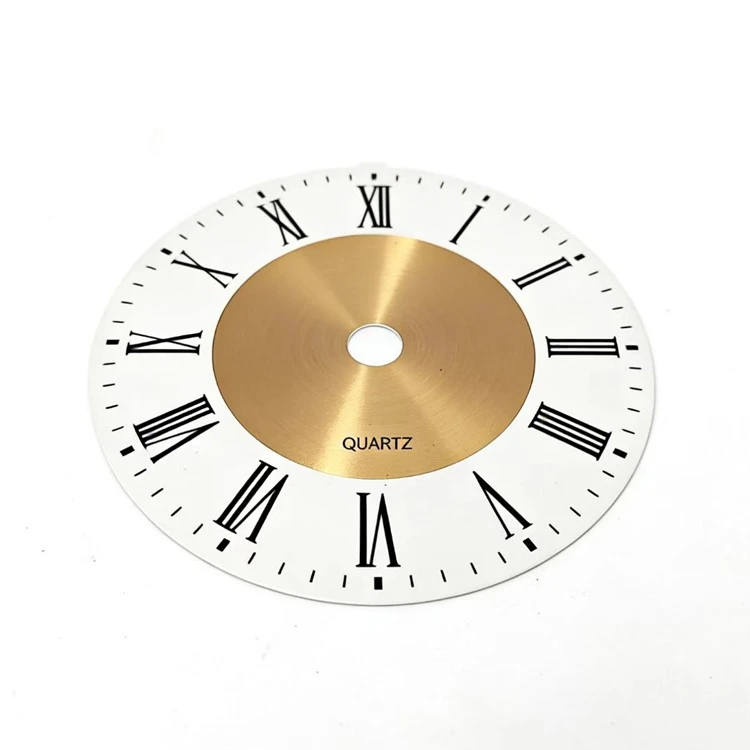
As a supplier of round clock dials, we understand the importance of the second hand in creating a functional and aesthetically pleasing timepiece. Our Clock Dial Face products are designed to accommodate the smooth movement of the second hand, ensuring accurate timekeeping. We offer a variety of options, including Aluminium Arabic Numerals Clock Face and 77.4mm Round Aluminium Clock Face, which are crafted with precision to allow the second hand to move freely and accurately.
In addition, our Clock Dial Replacement and 0.5mm Aluminium Hollow Clock Dial Replacement options are perfect for those looking to upgrade or repair their existing clocks. These replacement dials are designed to fit a wide range of clock models, ensuring that the second hand can continue to perform its vital function.
Contact Us for Your Clock Dial Needs
If you're in the market for high - quality round clock dials, we invite you to get in touch with us. Our team of experts is dedicated to providing you with the best products and services to meet your specific timekeeping needs. Whether you're a clock manufacturer, a repair technician, or an individual looking to build your own clock, we have the expertise and the products to help you succeed.
References
- Landes, David S. "Revolution in Time: Clocks and the Making of the Modern World." Harvard University Press, 1983.
- Whitrow, G. J. "The Natural Philosophy of Time." Routledge, 1980.
- Huygens, Christiaan. "Horologium Oscillatorium sive de motu pendulorum ad horologia aptato demonstrationes geometricae." Paris, 1673.


